

Leggi l’articolo in Italiano qui
With today’s article, the “Scooter of the Month” series crosses the Italian borders. More precisely, we find ourselves in Belgium, a country universally known for the Spa-Francorchamps Formula 1 circuit, for its chocolate, its fantastic craft beers with hundreds of qualities and varieties. Not to mention Belgian fries. Oh my, I’m getting hungry just writing this introduction. I’m back, sorry, I went to eat 2 kg of fries with Andalouse sauce. Yes, I know, I’m a big eater, but I love good food and Belgium is full of it.
I was saying, another couple of things that come from Belgium, more precisely from Manur, are Kevin and his Yamaha Jog-RR. As soon as I saw it, I was ASTONISHED by the details. It took me a good 10 minutes to pull myself together and immediately rush to write him something, hoping he would accept the possibility of letting us tell the story of this two-wheeled monster. Because I guarantee you, it is one.
But before diving into the article, as is my habit, I wanted to ask Kevin a ton of questions to get to know him better and to be able to tell you step by step how this Yamaha Jog was born and about his experience in this small but great world.
[SRD] Hi Kevin, first of all welcome and thank you for giving me some of your time. How are you and are you already ready for the next season?
[Kevin] Hi Jaco, I’m doing great, still motivated and passionate like when I was younger. During this winter I am actively preparing for 2026. For this new season I am building three personal Yamaha Jogs that will allow me to take part in various events: track days on beautiful circuits, but also endurance races lasting 5, 6 or more hours.
The first JOG, the one from my youth, is equipped with a 2FAST 100cc FLR engine on a horizontal Minarelli base with 2FAST Passion crankcases.
The second JOG, the one you recently saw in a photo, also runs a 2FAST 100cc FLR engine, but on Piaggio 8.1 crankcases. These two scooters are used for track days and some races on large circuits such as the Nürburgring in Germany or Clastres in France. This year I would also like to ride on the Écuyers circuit.
The third JOG is a 70cc, with 8.1 crankcases, and it is specifically designed for endurance races close to home. So this is a brief overview of my personal scooters. I am also preparing several JOGs for track rental. They are equipped with 2FAST 50cc engines on original horizontal Minarelli crankcases, and each of them will also have an additional 2FAST 70cc FLR and 100cc FLR engine on 2FAST Passion Minarelli crankcases.
[SRD] Damn, the list is very long. Before talking about THE Jog, I’d like to go back for a moment. How did you get into the scooter world and how was this passion born?
[Kevin] To understand that, we have to go back to the beginning of my passion, more than 15 years ago. At that time, like all the young people of my generation, we dreamed of having an MBK. At 17 I bought myself an MBK Nitro with some money my father had left me when he passed away, when I was 3 years old.
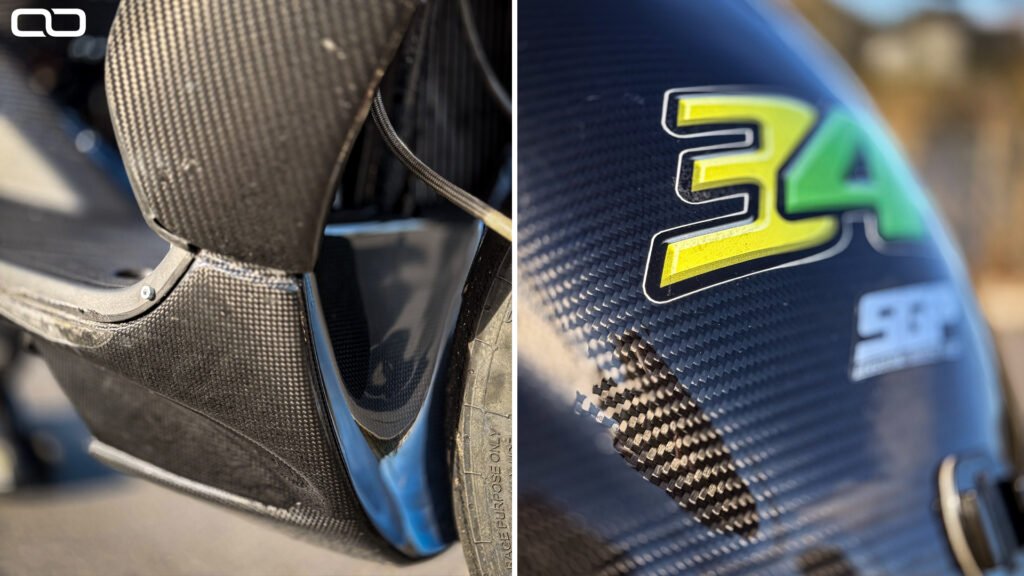
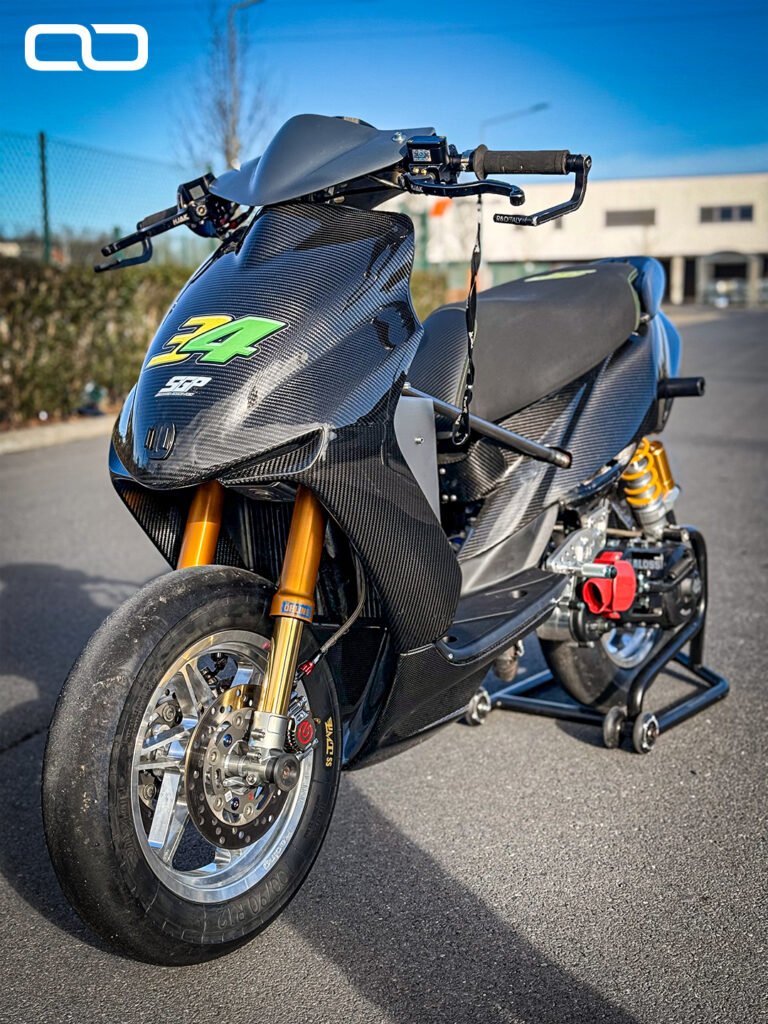
Fun Fact: he called me Kevin because, like me, he was passionate about two wheels. At the time his idol was Kevin Schwantz, number 34. So, to pay tribute to him, I carry the number 34 on my race scooters.
After buying this Nitro, which I loved riding, I wanted to improve it. That’s when I discovered the Maxiscoot website. I bought my first racing and tuning components there: a better front brake, some fairings for a more aggressive look and engine components. From there my passion for scooter customization was born. And since then I have never stopped, and today it is part of my job.
Around 2007–2008, when I was about 18 years old, near my home there were events that brought together mopeds, motorcycles and scooter races, including endurance races. I went to take a look and I fell in love with this sport immediately. So I decided to build a race scooter and I bought my JOG. At the same time, in France there were the ScooterPower meetings, which I attended with the Nitro, while I raced endurance events with the Jog. I won’t go into the full story of all my vehicles here, otherwise it would take pages and pages.
It was during this period that I discovered the 2FAST brand. I contacted Massimo directly by email and became a regular customer, building 2FAST engines for myself and for my friends.
[SRD] My father was also a huge fan of Schwantz, but also of Doohan, and consequently he passed this beautiful “disease” of motorcycling on to me from a very young age. Anyway, going back to the Jog, tell us about the bike: how it was born, how it evolved over time and whether you consider it finished in terms of development.
[Kevin] The Jog project started a long time ago. At the time, to take part in amateur races and get a decent result, you needed at least a 70cc single-ring engine. So I put together a Stage6 Racing 70cc engine that I had already assembled previously, finishing it using the resources and parts I had available. I took part in my first race and I fell in love with it. I immediately aimed for the top positions in the standings.
So, as soon as it came onto the market, I built an engine block with the Stage6 R/T 70cc. The Jog changed from day to night, a real rocket compared to before, capable of competing with the fastest. I was practically on the podium at every race, incredible.
In the following seasons, I took part in other races and track days with the 2race association, where the level was definitely much higher. I was 7 seconds slower than the riders who occupied the top positions. Trying to keep up with them, I realized that the stock frame was at its limit. The consequence was obvious: I had to modify it. In addition to the frame, I also had to modify the engine mount in order to have it perfectly straight and rigid. Then the chassis was also completely overhauled.
(Kevin is telling me every single detail of the modifications here, we will see them later in depth during the article.)
The performance of the Jog had changed drastically. I had an exceptional feeling and the lap times kept improving. Finally I could keep up with the best riders in the championship. Even more motivated, I continued to develop the bike year after year with new components. I kept working on the frame and made carbon fiber fairings to reduce weight. Every year I set myself new goals.
Fun Fact: one day, during a track day at Spa-Francorchamps, a German gentleman approached me in the pits and offered me the chance to ride with them at the Nürburgring, the Formula 1 circuit, not the Green Hell. Needless to say, one month later I found myself at the Nürburgring with very high-level European riders, especially Germans. It was my first time on a circuit of that size: insane speeds for a scooter, very fast corners and incredible battles with top-level riders.
I finished that crazy weekend with the best absolute lap time: 2’26”, beating the record of previous editions, and a top speed close to 160 km/h. This experience motivated me like never before and gave me new goals: lower the lap time even more and reach 170 km/h.
The development plans for the JOG are numerous: replacing the remaining plastic parts with carbon replicas, improving aerodynamics and reducing the total weight to under 70 kg, optimizing every single component.
[SRD] I would like to say you are crazy, but from this answer it is clear how much you are in love with this sport. Outside of racing and the track, how do you live this passion?
[Kevin] Unfortunately, living this passion to the fullest is not possible alone. It takes a large group of people, sharing, organization and participation in events to keep it alive and to evolve the scene. That’s why I decided to become a professional in this field, creating a workshop for frame and engine preparation, launching a website for selling high-performance parts and developing my own brand by creating racing components: SGP (Scooter Grand Prix). Building high end performance vehicles for rental. And finally creating a non-profit association to organize events dedicated to this discipline.
All of this for one single goal: to fuel the passion and also allow other enthusiasts, who may not have the mechanical skills or the financial resources, to fully experience the world of scooter racing.
[SRD] To wrap things up, I have a small personal curiosity: how do you think the Italian scooter scene is perceived abroad?
[Kevin] The Italian scene is a great source of inspiration. Seeing major brands such as Polini, Malossi, 2Fast, 8.1, etc., as well as passionate tuners who create components and use them in Italian competitions, is truly incredible.
I asked Kevin other questions as well, which he answered in a very thorough way, but I would have really extended the interview too much, so I selected the most interesting parts without distorting them. Sorry Kevin, I’ll buy you a couple of beers at the next Scooter Racing Day.
From what you have read, it is clear that beyond our borders there are die-hard enthusiasts for this world, people who truly love, just like all of us, everything that connects scooters in their various disciplines and peculiarities. I thank Kevin once again for the time he spent with us, and now we dive into observing every detail of this Yamaha Jog-R that he created with his own hands and that has absolutely nothing ordinary about it.
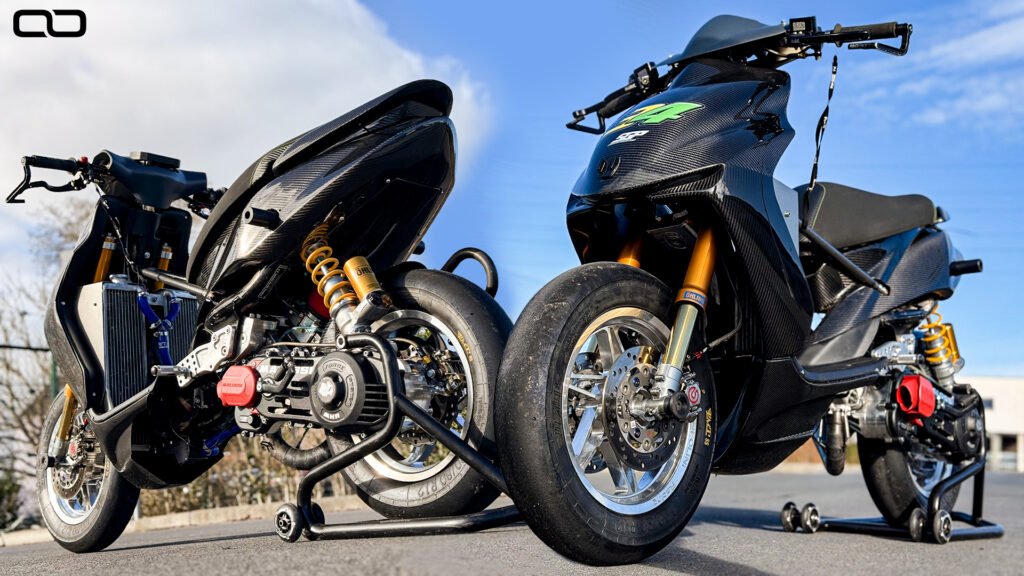
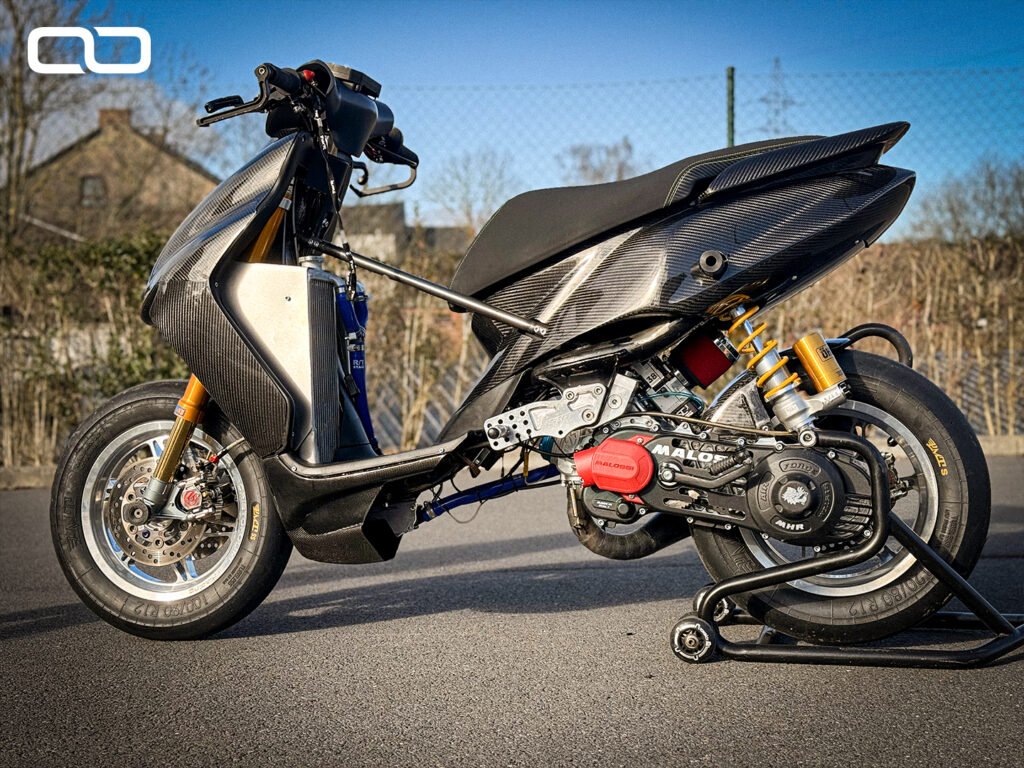
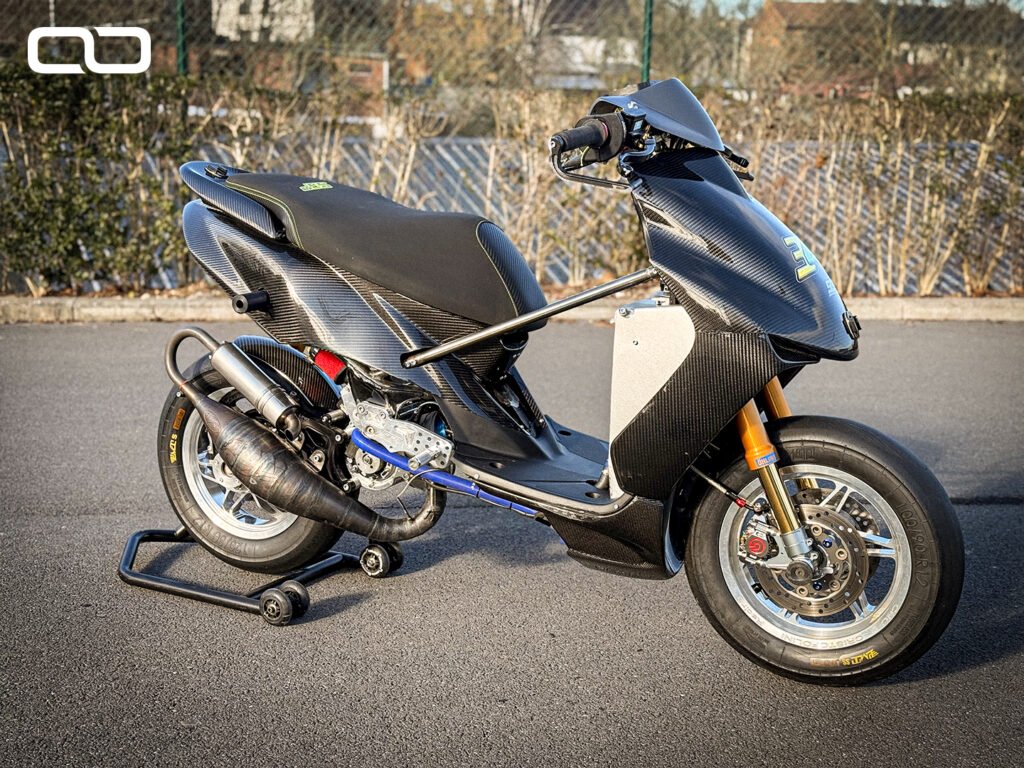
With this Scooter of the Month we stay within the Yamaha/Minarelli family, but with a horizontally oriented engine crankcase. The starting base is a Yamaha Jog-RR that has been turned inside out from top to bottom. It boasts a quantity of very high-profile components, in some cases going beyond the consumer market, and Kevin is both the proud owner and builder of it.
So now let’s go and dissect every single detail, screw, bolt and clamp of this machine, bombarded with every possible good thing!
Engine:
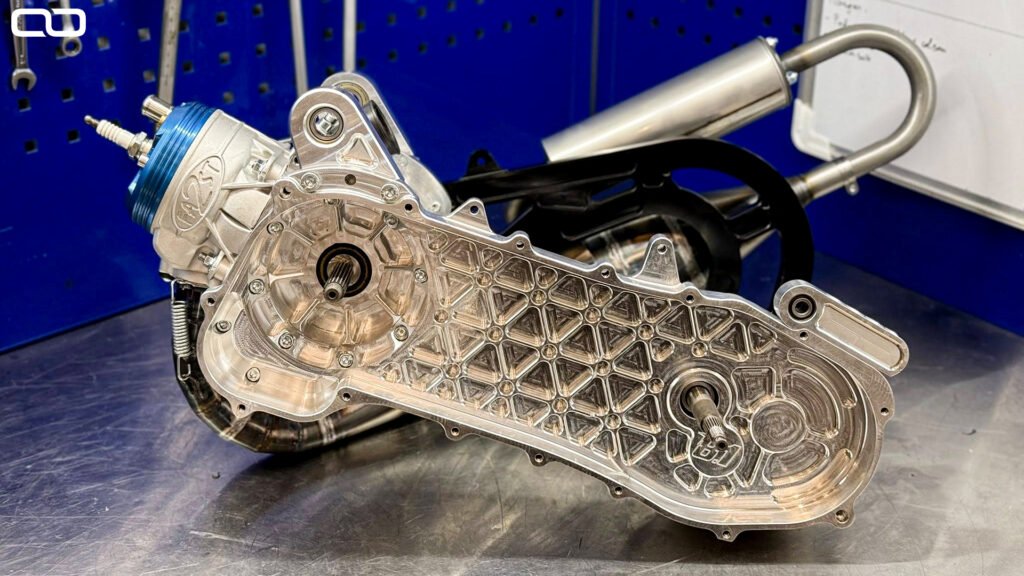
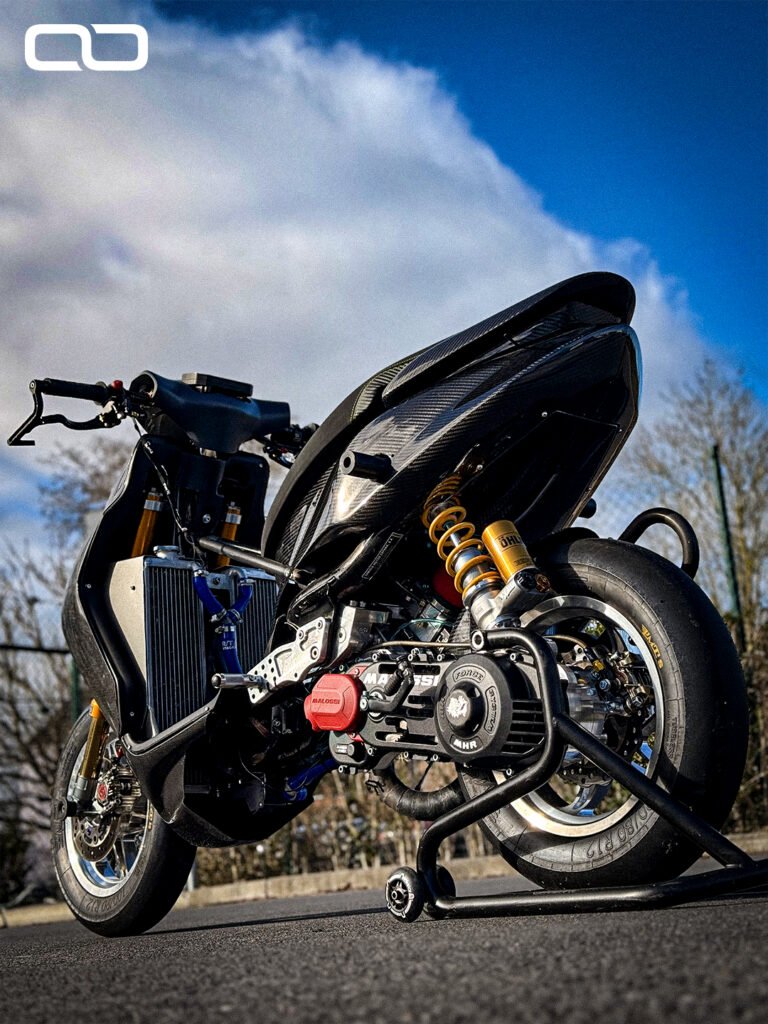
Let’s start with the engine block. Our Belgian friend opted for 8.1 Fireblade crankcases. More precisely, and for those living under a rock: these are CNC-machined billet aluminum crankcases, whose design features the Minarelli subframe mounting with upper bushings and Piaggio long-arm transmission components.
These crankcases are natively designed for 100cc flanged cylinders and carburetors with diameters ranging from 34 mm up to 39 mm. In addition, they have several advantages and design solutions that stock crankcases do not offer.
The first is the possibility of being modular, meaning that the transmission side can be separated from the crank chamber without the need to remove the entire engine, the crankshaft, the ignition or the intake system. Furthermore, the gear cover is located on the outer side of the engine block, rather than being sacrificed under the torque driver. Obviously, everything has been redesigned, allowing the final gear ratio to be modified without removing additional components, speeding up the setup process and eliminating the annoying task of cleaning oil from inside the transmission compartment.
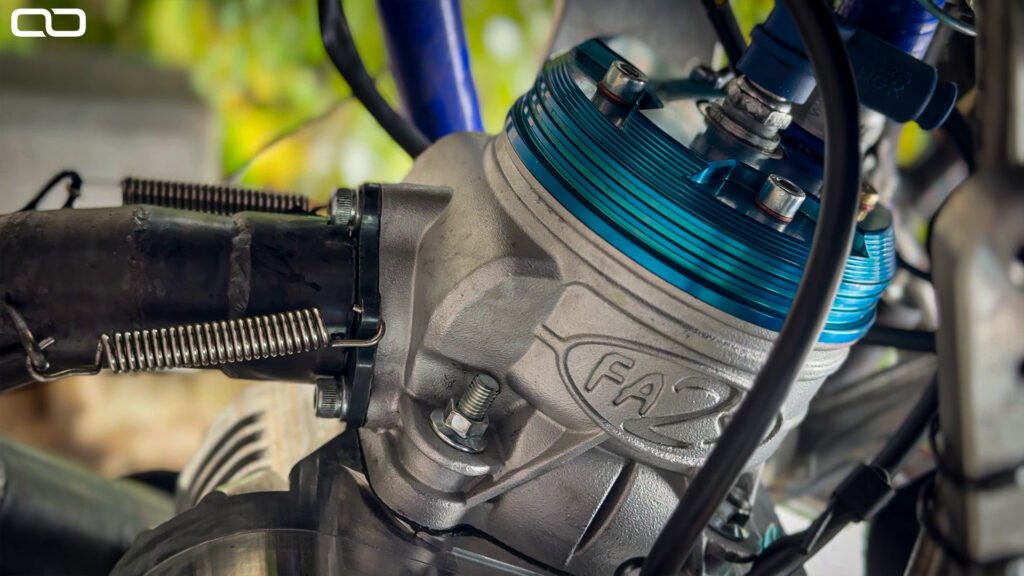
Inside this aluminum work of art we find a 8.1 crankshaft with 47 mm stroke and 100 mm connecting rod, with a 14 mm diameter wrist pin, which forcefully drives the 52 mm bore piston inside the imposing cylinder kit from TRTeam, the 2Fast 100cc FLR.
A cylinder kit featuring 5 transfer ports, split exhaust with a bridge, external studs and a separable cylinder head with the unmistakable anodized blue typical of TRTeam engine.
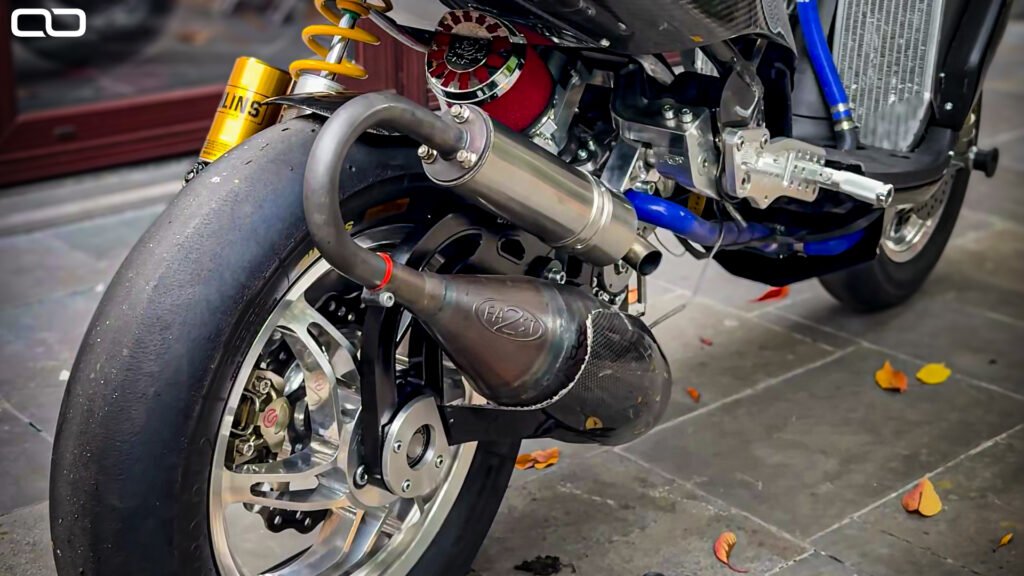
Completing the 2Fast kit and unleashing the engine’s scream beyond 13,500 rpm is the dedicated 2Fast expansion exhaust, enhanced by a custom-made carbon fiber exhaust guard crafted by Kevin.
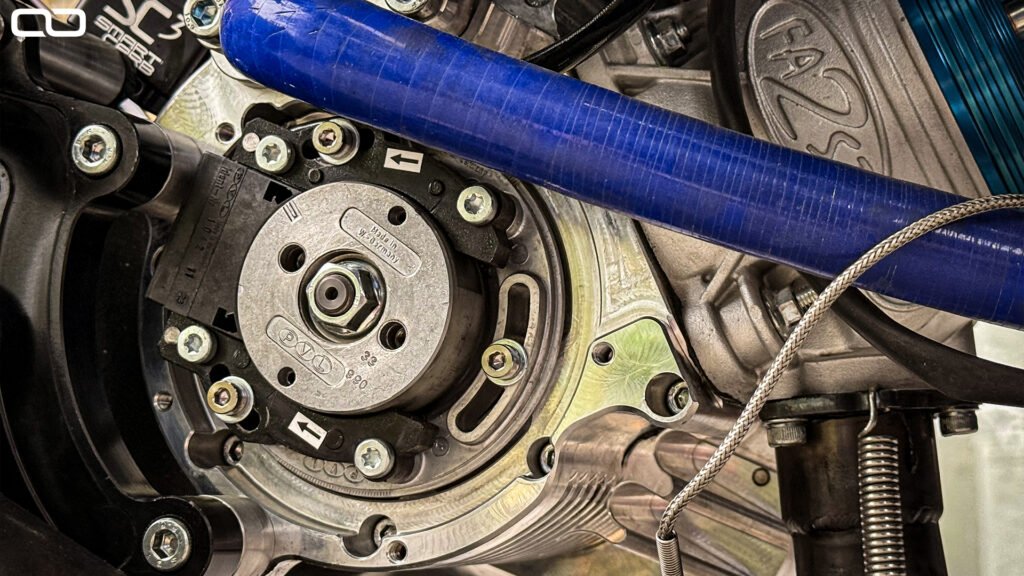
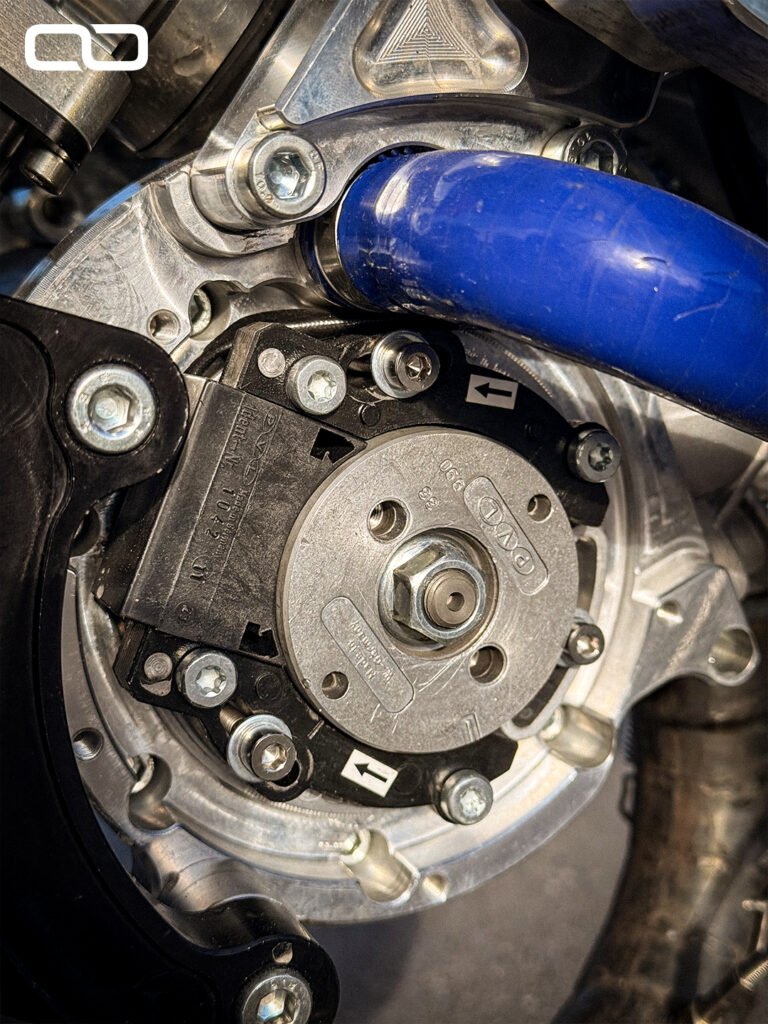
The ignition/electronics department is managed by what we Italians, back in the day, nicknamed “La Rossa” (which in this case has nothing red about it), namely the Stage6 PVL R/T internal rotor ignition, the competitor of “La Bionda”, the Malossi Selettra, to be clear.
Connected to the ignition we find an NGK spark plug wire with its matching cap and an NGK 105 short-thread spark plug.
For context: Italian enthusiasts often gave these ignition systems playful nicknames based on hair color, which is why they became known as “La Rossa” and “La Bionda.” In reality, the Stage6 was originally anodized orange with red-tinged shades, while the Malossi Selettra Team 1 was yellow.
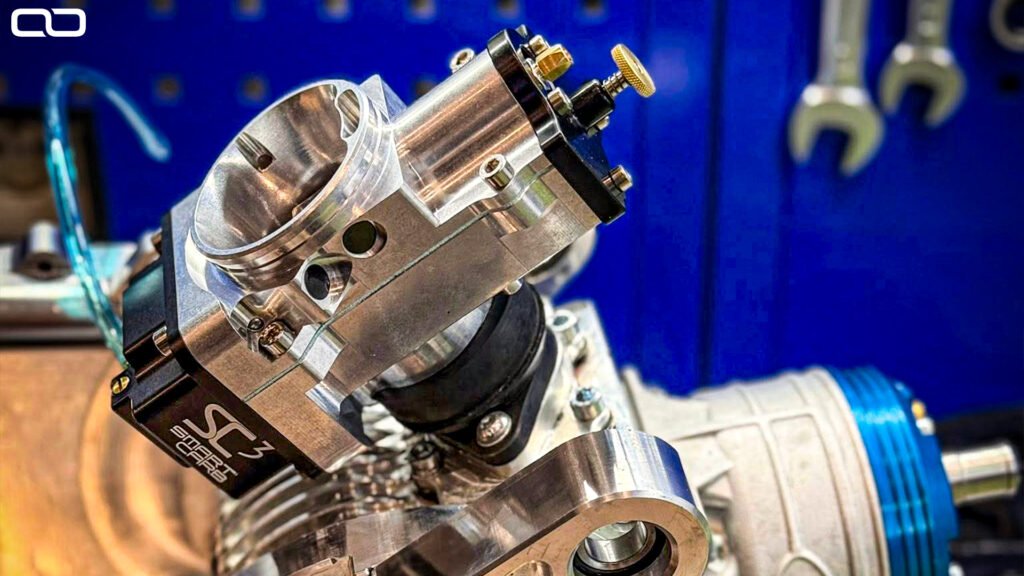
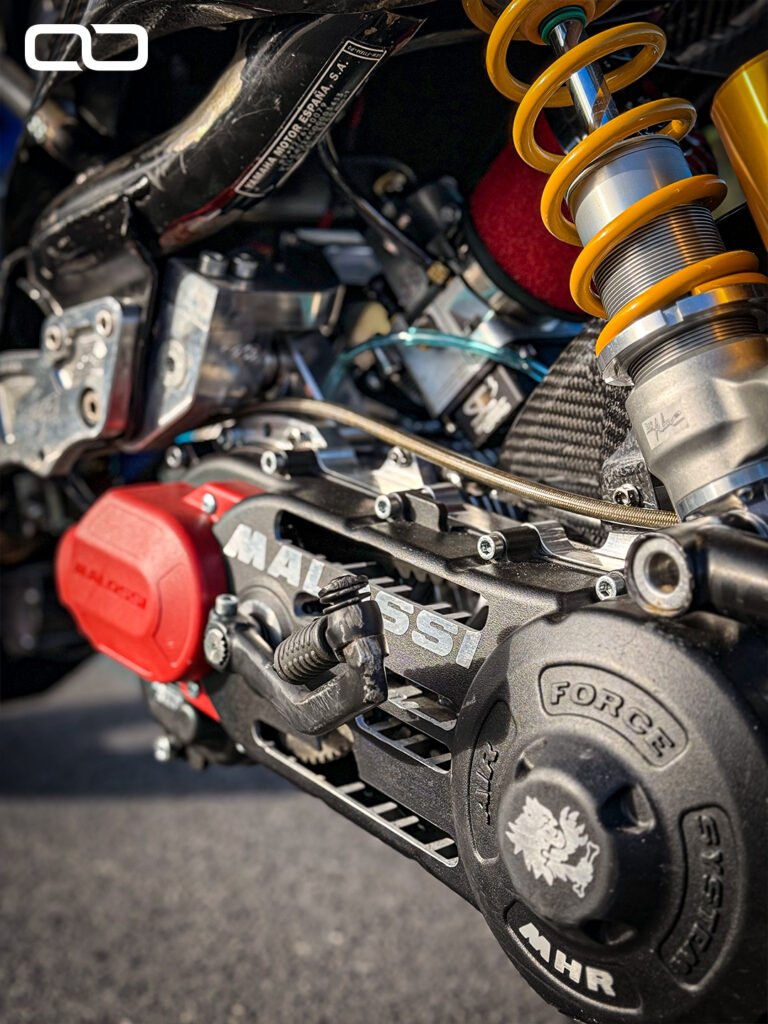
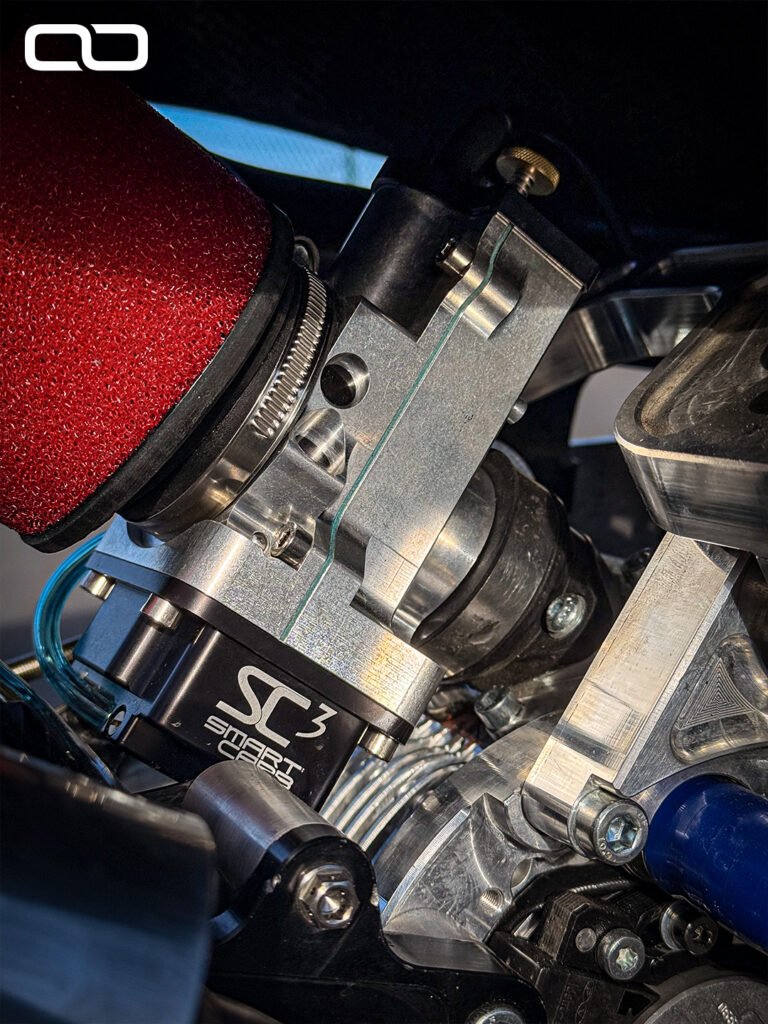
To deliver the fresh mixture to the hungry 100cc, a truly respectable intake system takes care of it. Starting with the filter, we have a touch of Malossi red: specifically, an E13 filter connected to a 38mm Smartcarb carburetor. The whole setup is paired with a complete K12 intake system, also from 8.1, namely: a short intake manifold, a 4-way bi-petal reed block, and the corresponding flow guide machined from solid.
This intake system was born, designed, and built specifically for the Fireblade crankcases.
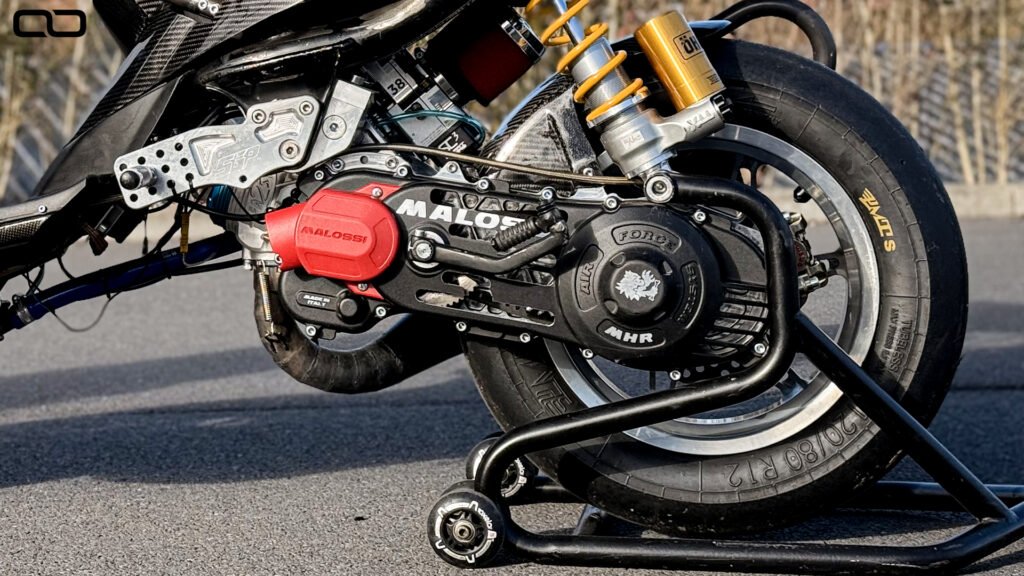
Unfortunately, we don’t have photographs of the transmission, but I invite you to mentally remove the Malossi crankcase cover and imagine a top-tier transmission setup. On the crankshaft, we find a Polini Evolution variator paired with a 2Fast fixed pulley. This drives a Polini Evolution belt, which in turn moves a 134mm 2Fast torque driver from TRTeam. Mounted on the torque driver, we have a complete Stage6 R/T clutch and bell assembly.
To complete the transmission setup, there is the gear pair. The gearing used on this Jog is as follows: the primary gear is 14/39, while the secondary is 14/47.
Chassis & Frame:
If the engine block is top-notch in terms of components, the chassis is beyond logic. Kevin literally decided not to settle for what the market offers and went beyond it, opting to adapt a Moto3 chassis. Starting from the rear, we find a solid-machined rear wheel designed by Team Cristofolini, paired with a black anodized 8.1 Torsen.
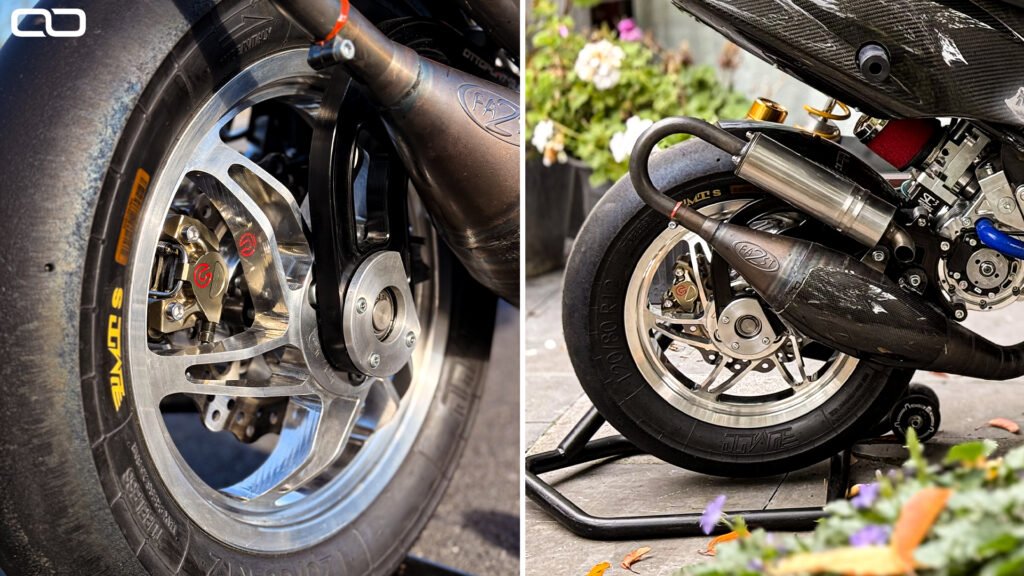
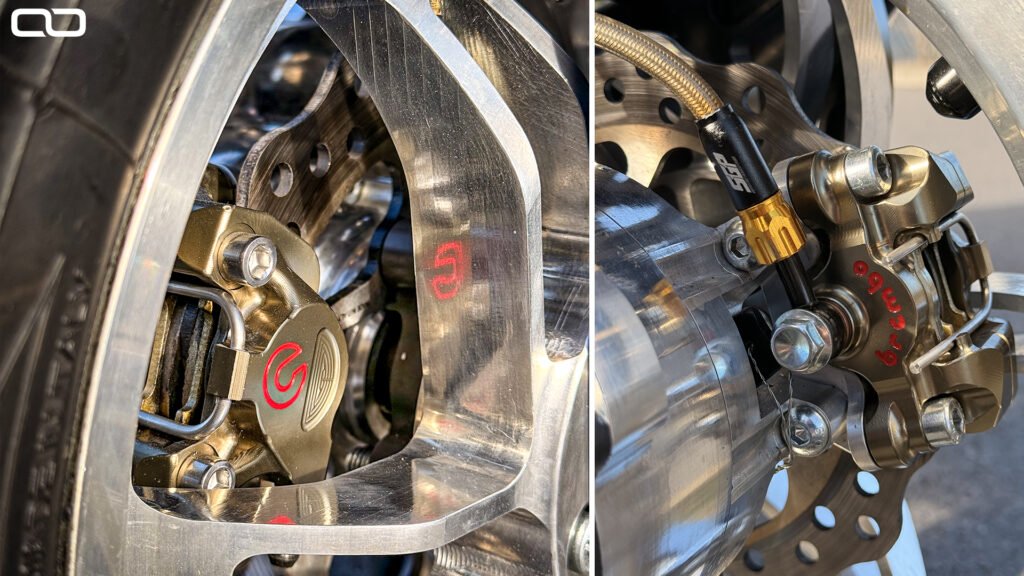
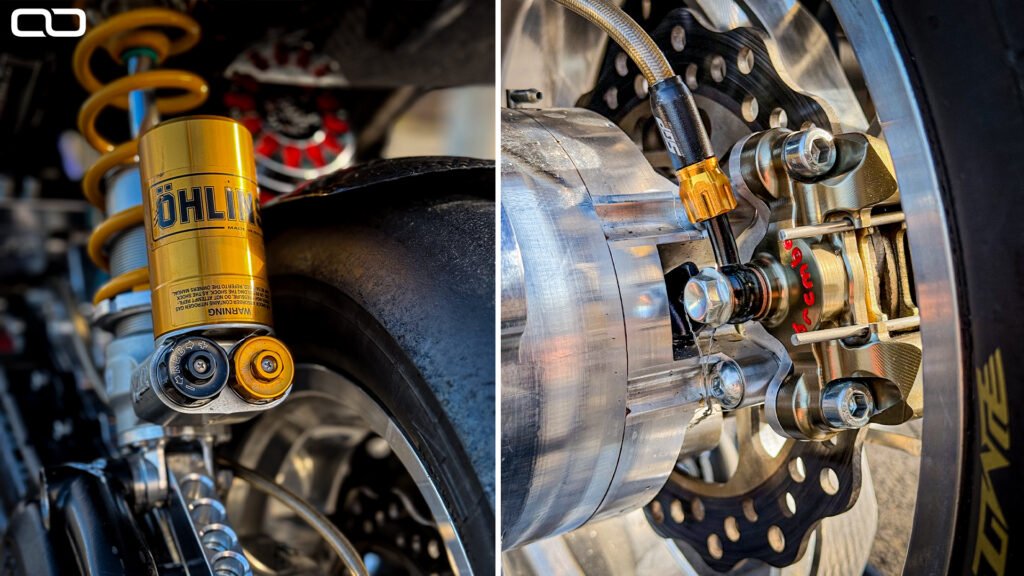
I know you have sharp and attentive eyes, and you have surely already noticed something gold peeking through the spokes of the wheel, and that red logo is quite recognizable. The rear brake is a 69.5mm radial type and comes directly from the MotoGP scene. It is a Brembo caliper, with two 32mm pistons. This marvel bites into a 202mm Polini rear brake disc. The braided brake line was custom-made by SGP (Kevin’s brand).
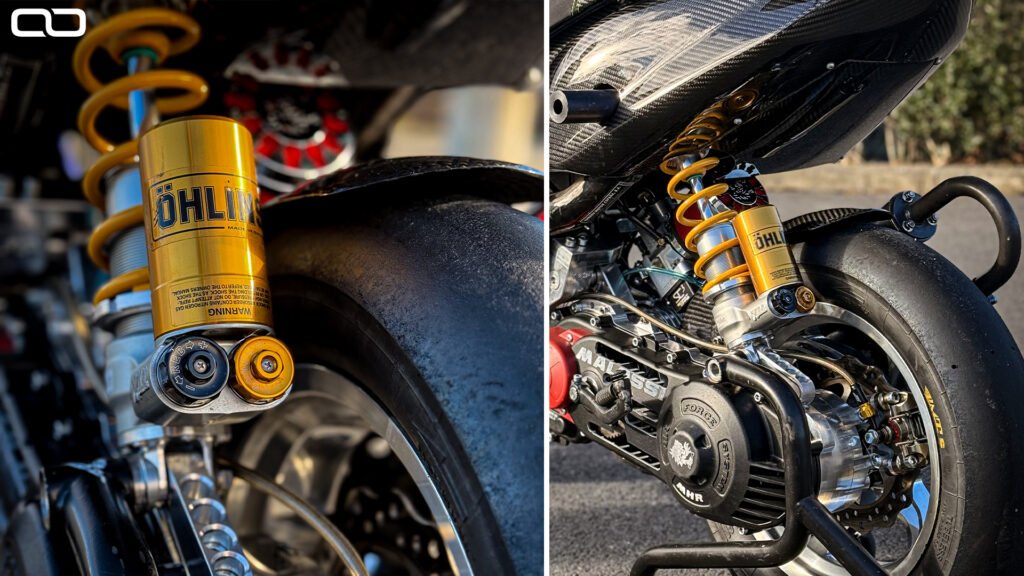
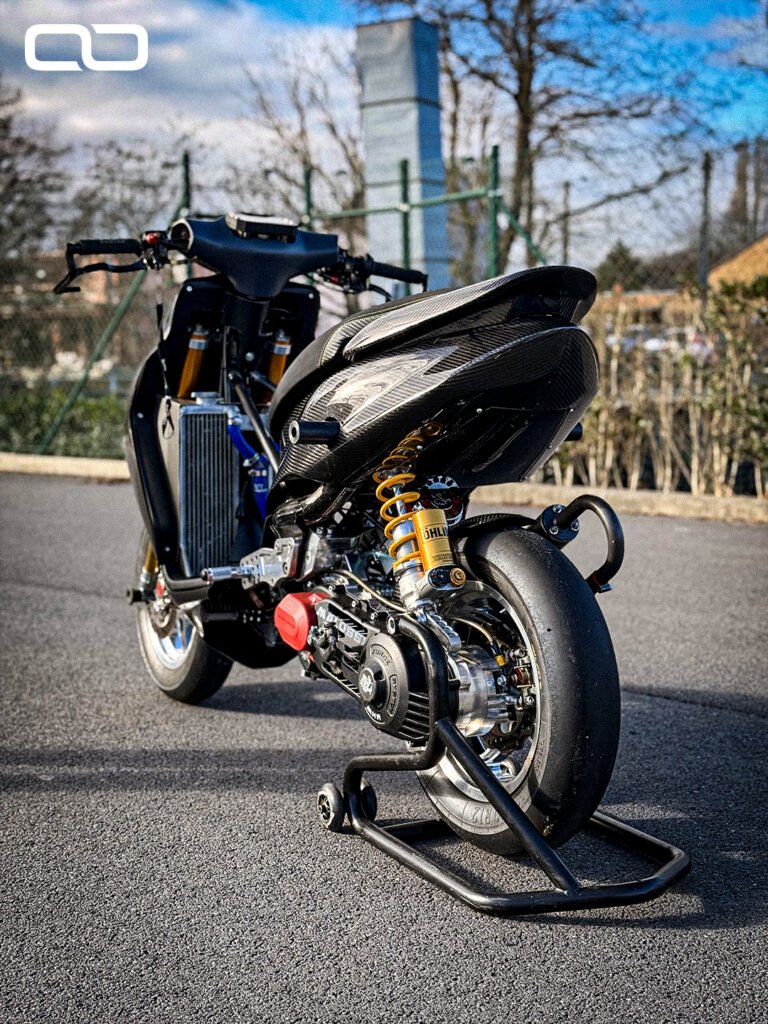
Nearby, something catches the eye and there it stands in all its glory: a rear Öhlins TTX36 shock absorber, modified to fit the Jog by Abe, a well-known Spanish tuner specializing in track components for Jogs. The suspension spring was custom-made by Abe himself, adapting it to the bike and Kevin’s weight. The shock features a 36mm internal piston and, in addition to the classic nitrogen expansion reservoir, it is fully adjustable in spring preload, low- and high-speed compression, as well as rebound and extension.
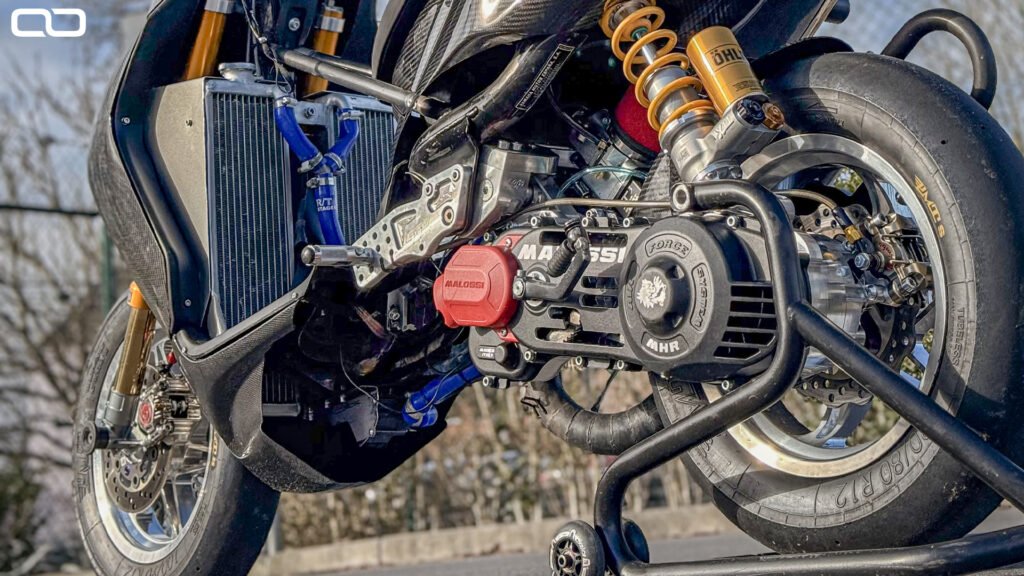
Looking slightly ahead, it is possible to spot a block-support subframe, machined from solid and specifically designed to be mounted and locked to the frame, thus preventing the typical low-to-high oscillating movement of Minarelli horizontal engines during acceleration. This ensures extreme rigidity, favoring scooter control in corners and during direction changes, where one often has to close or partially open the throttle. Not to mention, cornering stability also benefits, avoiding sudden wobbles that compromise the feeling and perception transmitted from the wheels to the rider.
Believe me, if you’ve never tried it, locking the subframe on a Minarelli bike drastically changes its behavior on track: it’s safer, more honest, it’s simply more! Clearly, this type of modification can disadvantage some road-riding comforts: increased vibrations and stresses transmitted to the rider, though nothing that cannot be mitigated with excellent silentblocks and materials that dampen excessive vibrations. This is a general discussion; I haven’t tried Kevin’s subframe myself, I’m basing this on my experience before and after locking the subframe on my Aerox back in the day.
Flanking the SGP subframe, we find beautiful adjustable footpegs, also machined from solid and made following the design of our friend Kevin.
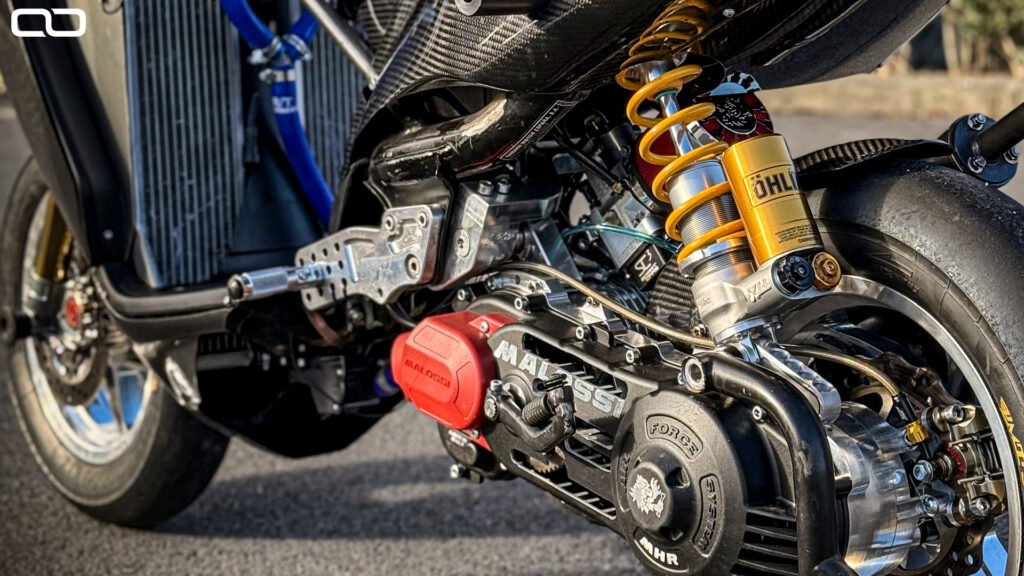
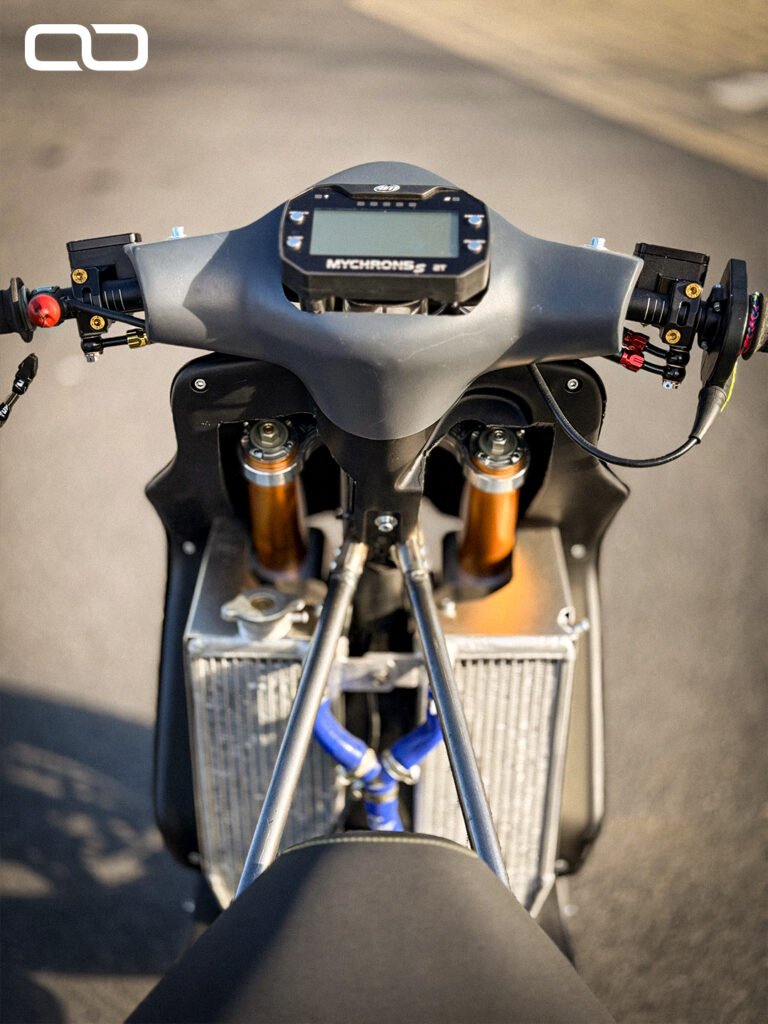
Just above the engine block, two stiffening and anti-torsion bars are clearly visible, connected between the rear part of the frame and the steering head. And this is where things get really interesting for the front end.
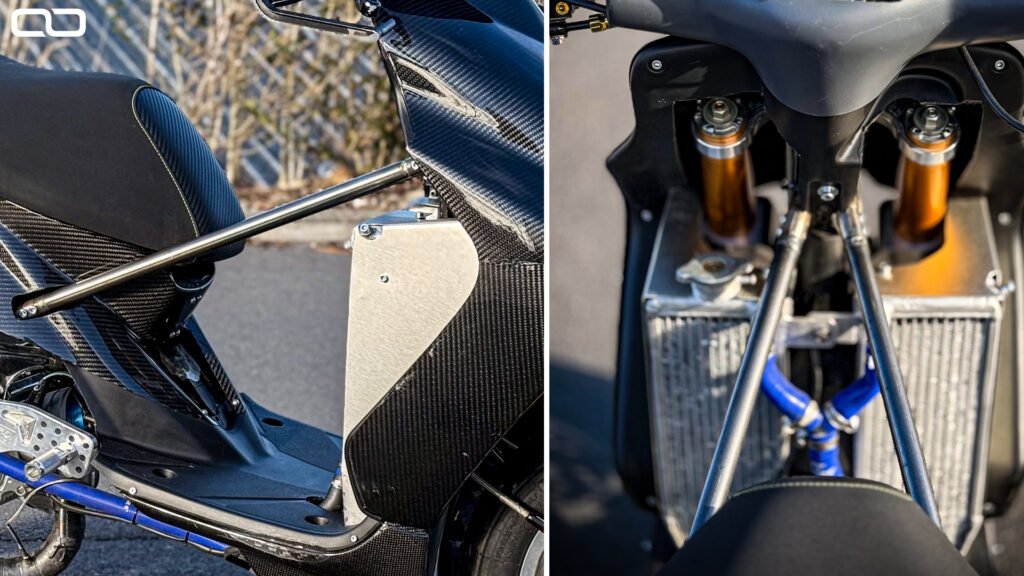
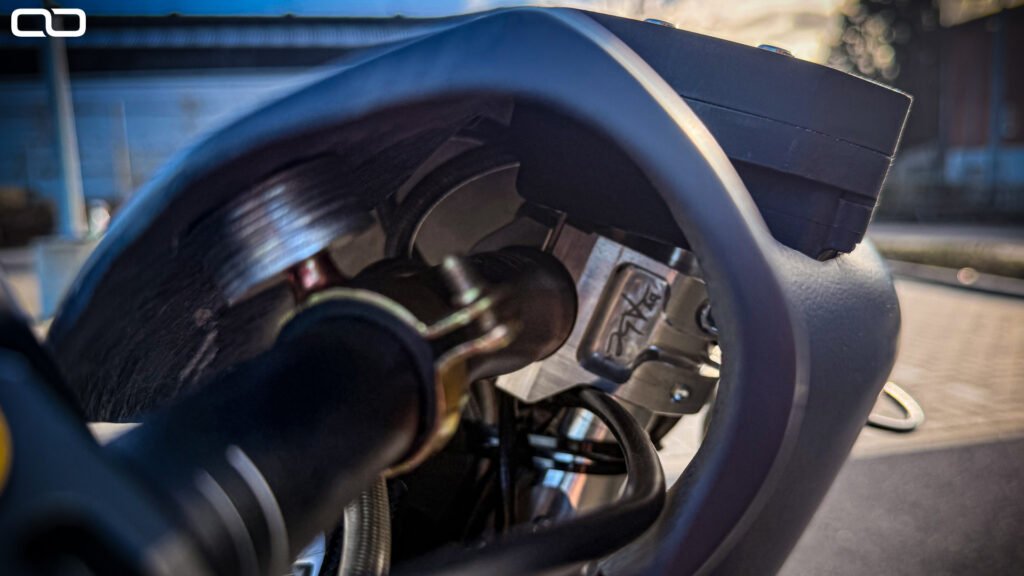
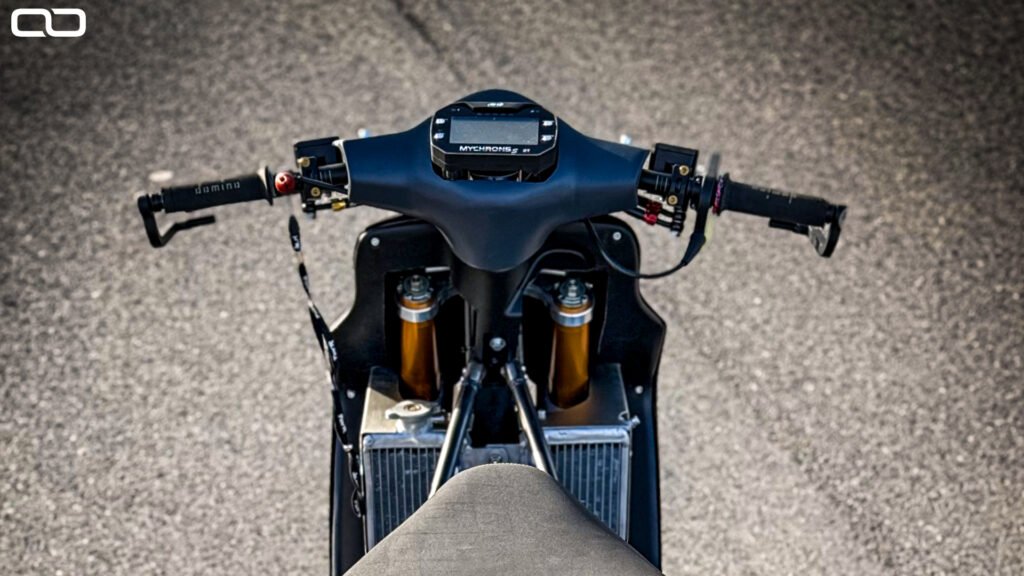
Hidden under the fairing, we find an adjustable steering stem by Abe, fitted with a handlebar derived from a mountain bike.
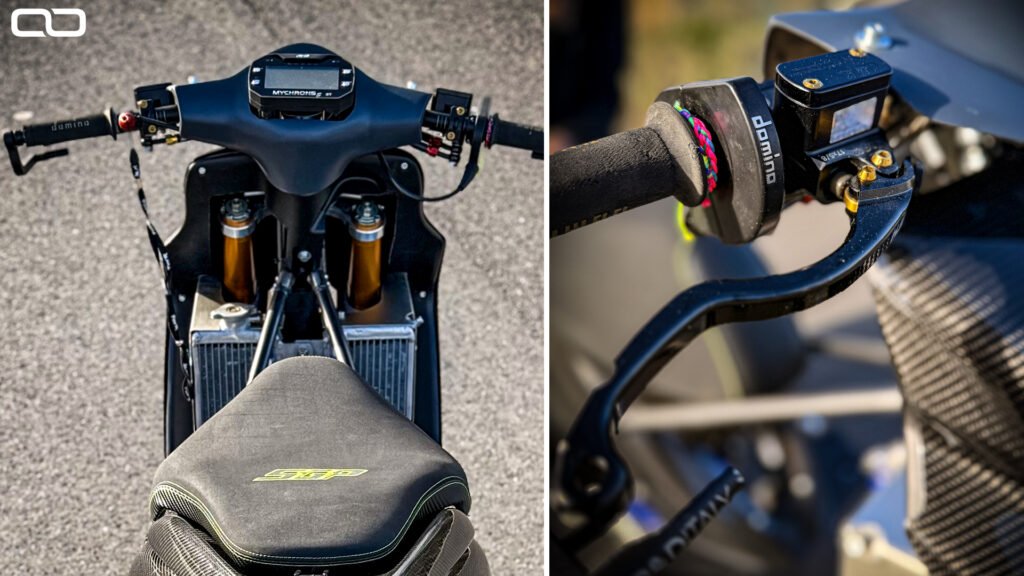
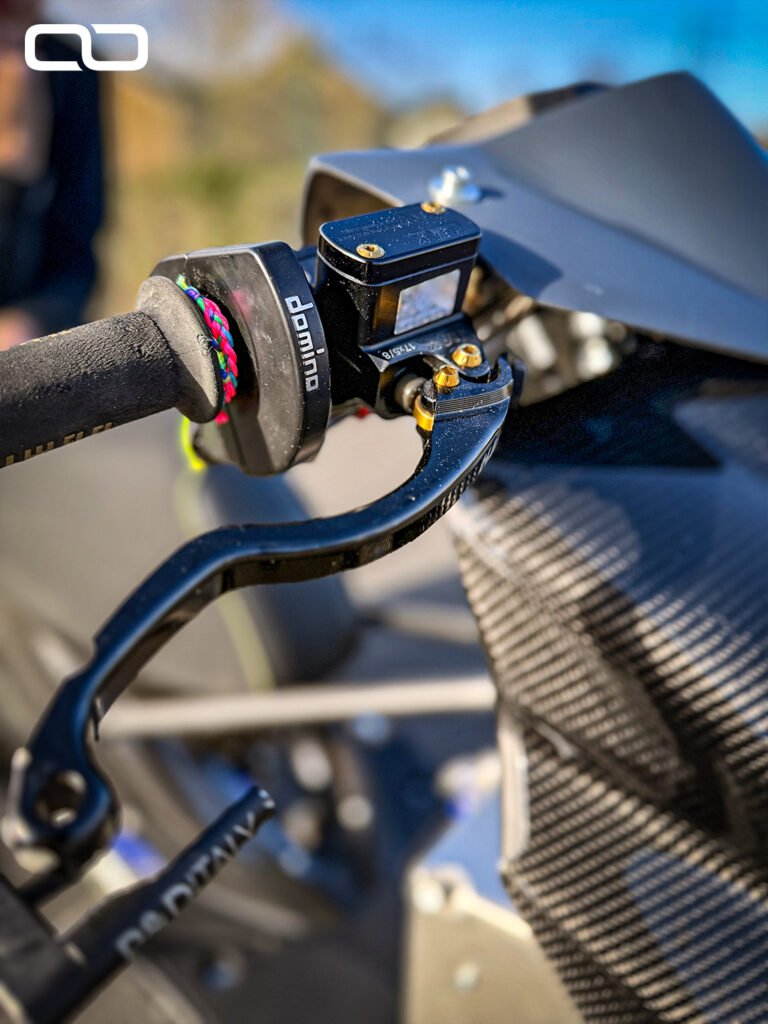
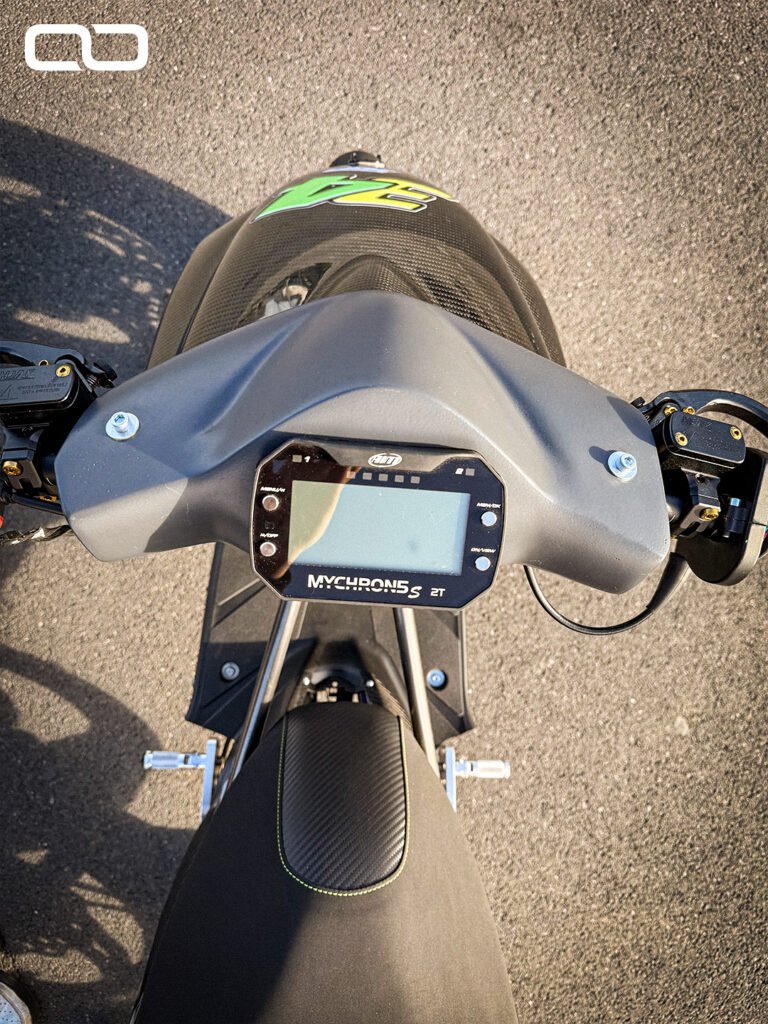
Above it, there is an Aim Micron 5S 2T dashboard, with water temperature sensors, a lambda probe for the exhaust gases, and, of course, the GPS for lap times. On both sides of the dashboard, we find two 17.5mm HJAK radial brake master cylinders with their respective brake levers, protected by another vintage touch: R&D Italy lever guards.
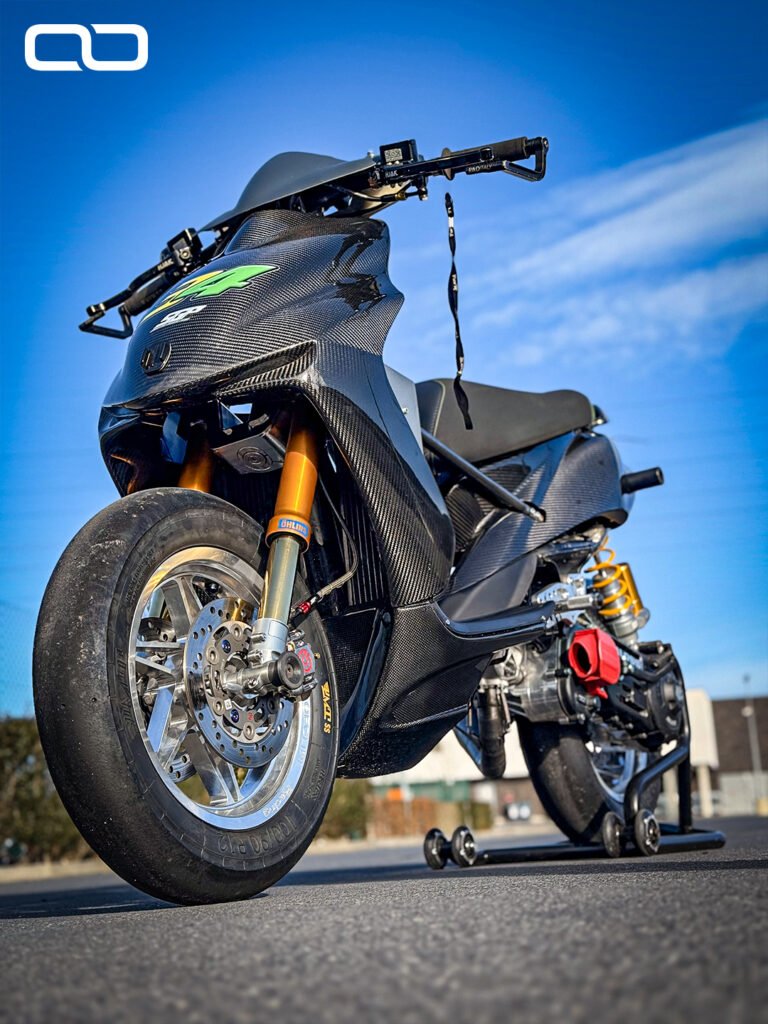
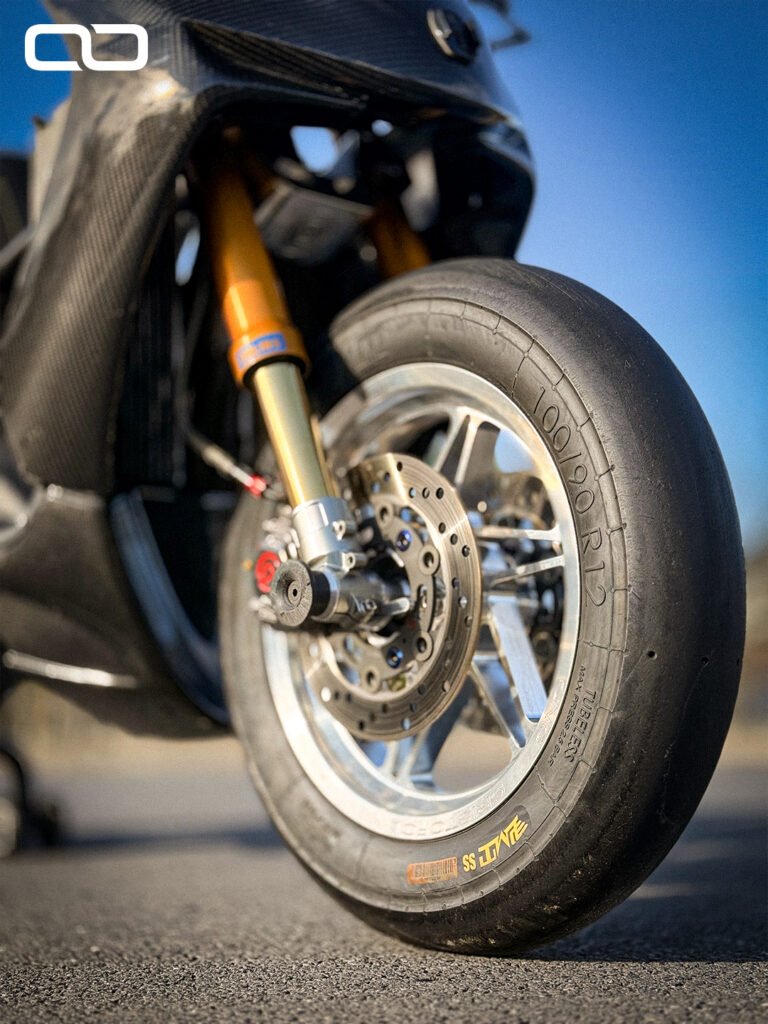
I know you’re eager to look further down, so I’ll indulge you: below the steering head, we find a double CNC-machined triple clamp that holds two Öhlins FG595 fork legs, coming straight from Moto3. These adjustable fork legs have a single leg diameter of 38mm with a TiN (Titanium Nitride) surface treatment, a typical high-end process from the Swedish company. It drastically increases surface hardness, improves wear and corrosion resistance, and also reduces friction, enhancing smoothness and increasing durability over time. The axle is made of titanium and has a diameter of 15mm.
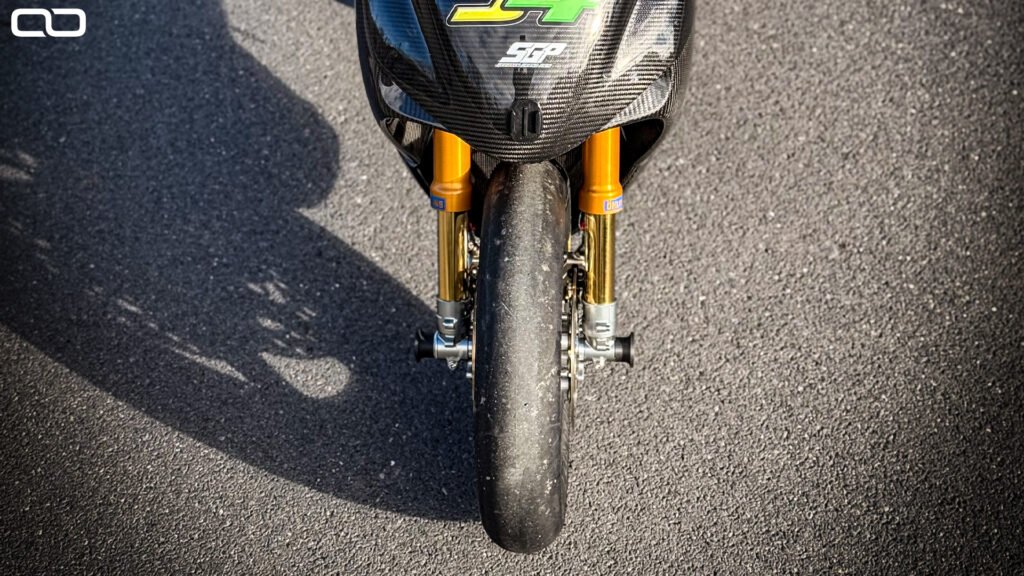
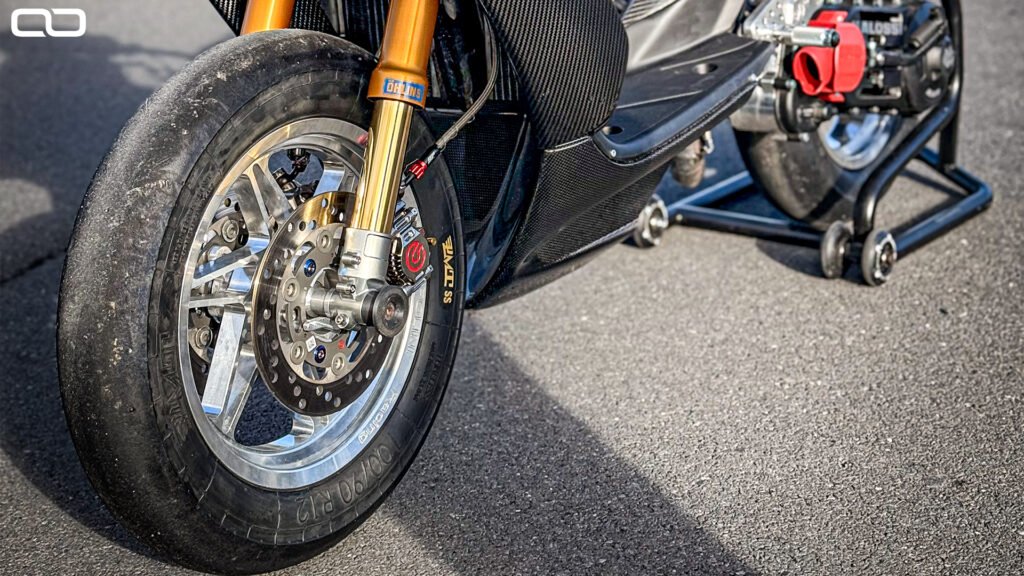
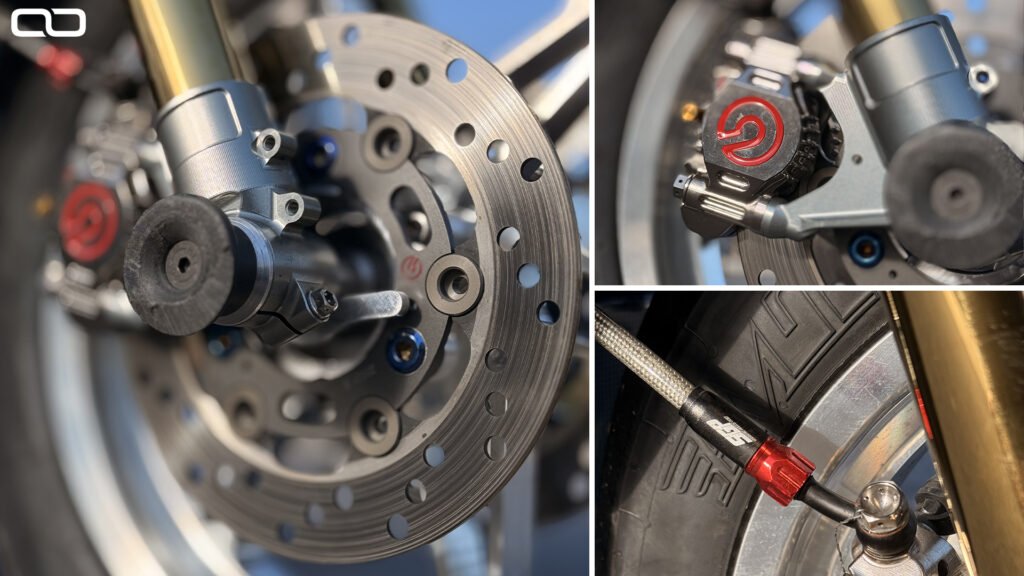
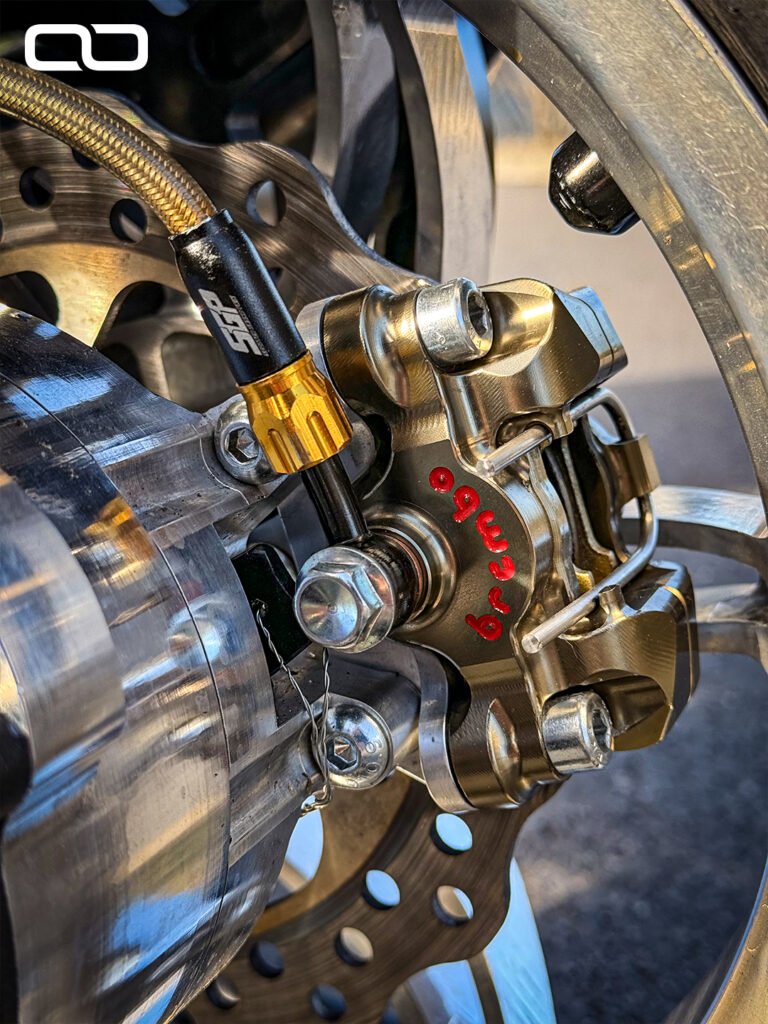
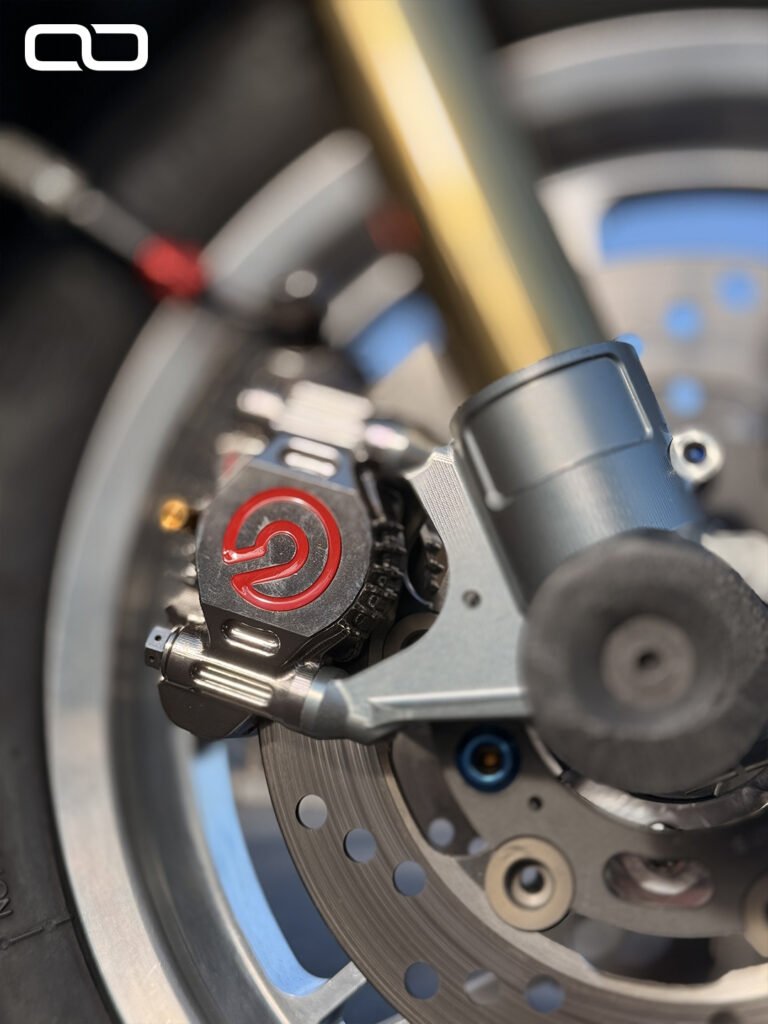
On the front axle, we find the sibling of the rear wheel by Team Cristofolini, with the possibility to mount not one but two brake discs. In fact, there are two 200mm floating Brembo steel discs derived from Moto3. No, your eyes aren’t playing tricks on you, this Jog has a dual braking system.
The brake discs are literally bitten by another two Brembo 60mm radial calipers, also coming from the MotoGP scene. They are single-piece CNC-machined monoblocks with two 32mm pistons that push the brake pads onto the floating discs.
For the cherry on top, there are two braided brake lines custom-made by Kevin, delivering DOT4 brake fluid to the calipers. Now you understand why I said at the beginning that there are very few consumer-market components here. This is a full MotoGP-level chassis. Kevin, you are insane, and I say it with a smile on my face.
Cooling System and Carbon Fairing:
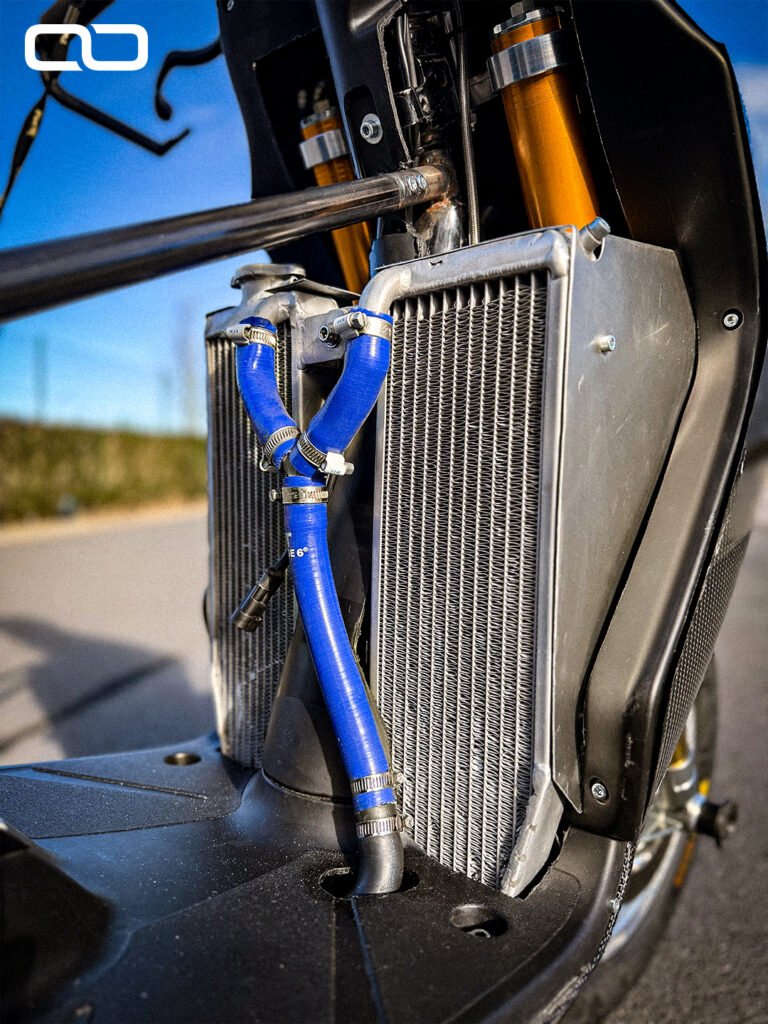
If you think the engine block is scary, and the chassis is out of this world, do you think anyone here spared expenses? Of course not. To cool the fiery spirits of a wild 2Fast, Kevin built two custom radiators complete with ducts and placed them in the classic position we are now used to, behind the leg shield. The difference is that the lower fairing nose also acts as an air duct, as the two radiators extend along their length to just a few centimeters from the tip of the lower fairing.
Transporting the massive amount of water through Stage6 R/T silicone hoses is an electric Bosch water pump.
Don’t worry, we’re in the final stretch. I know this is a very long article, but I just can’t stop writing. Anyway, we’re almost at the end.
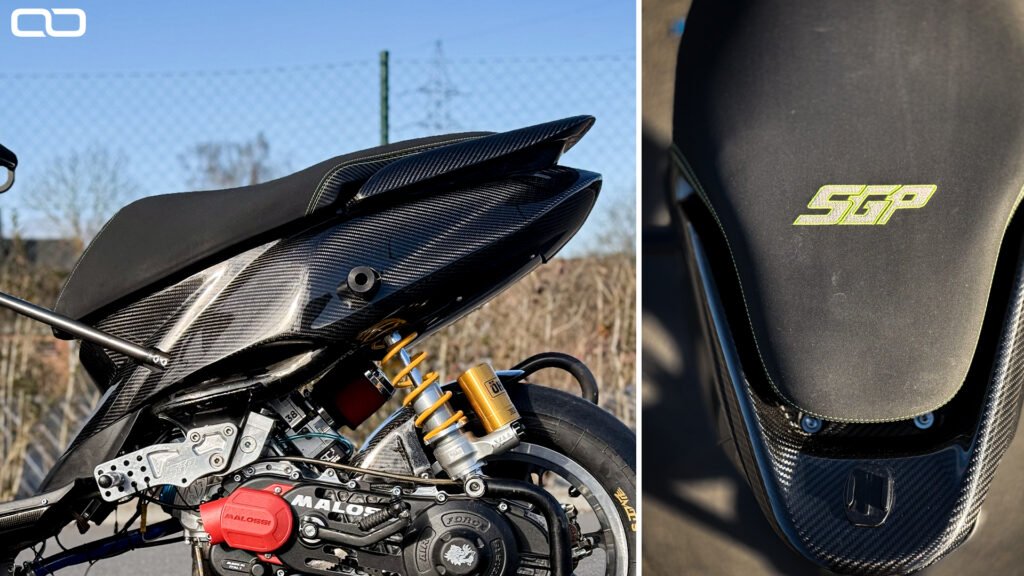
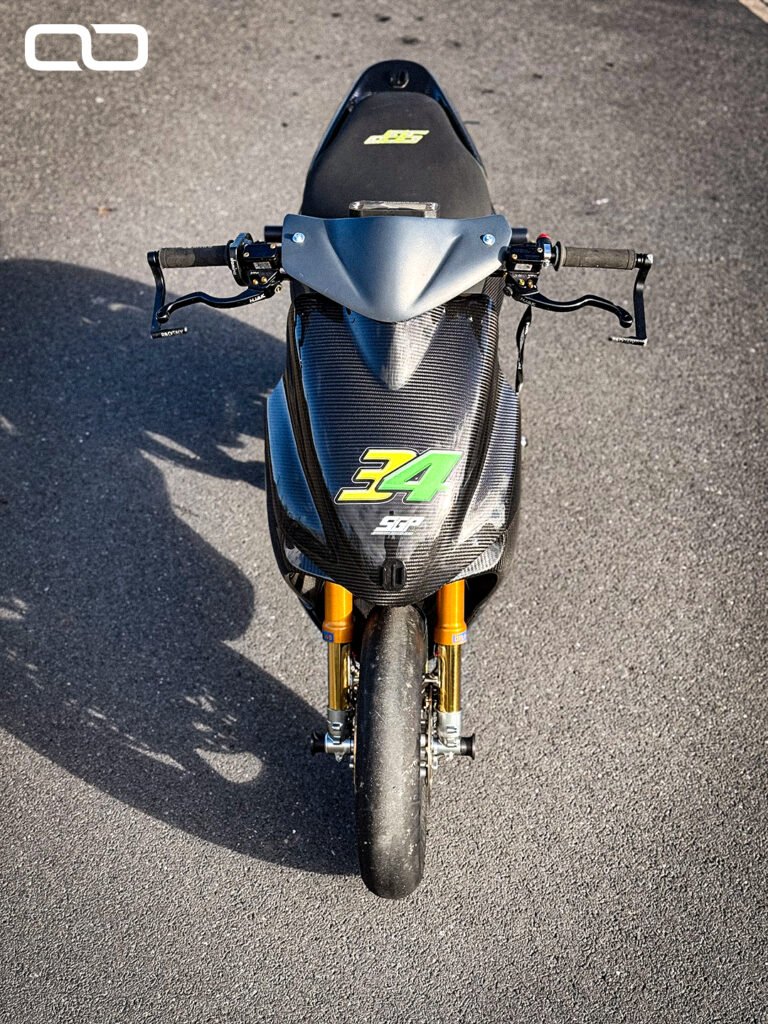
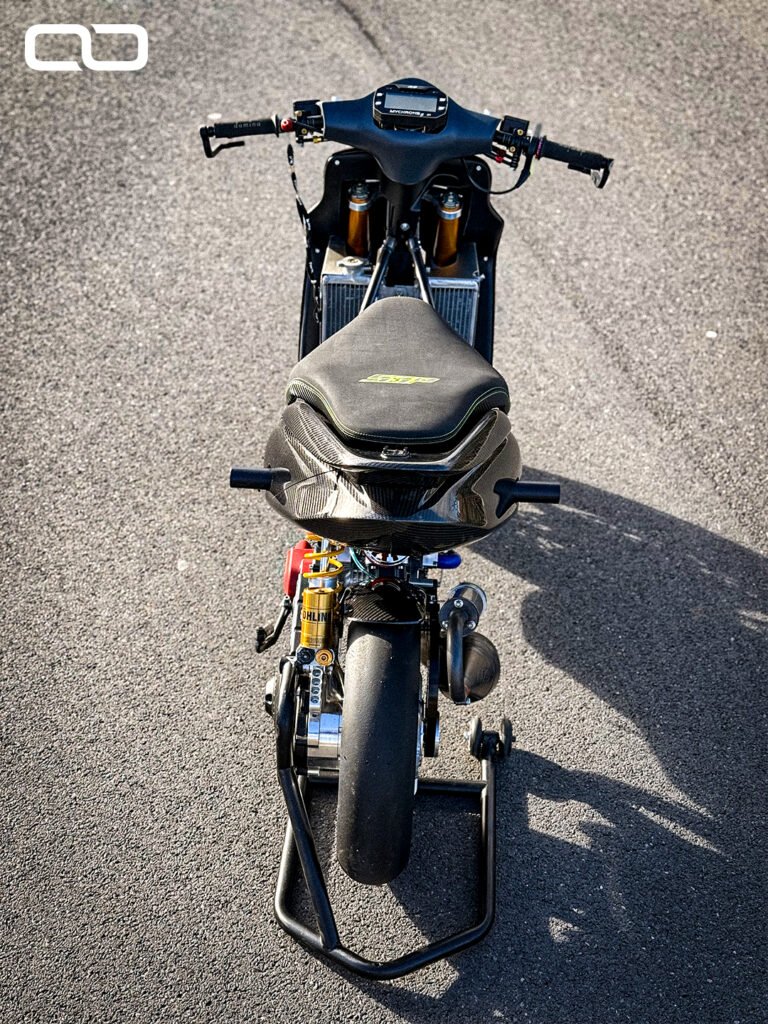
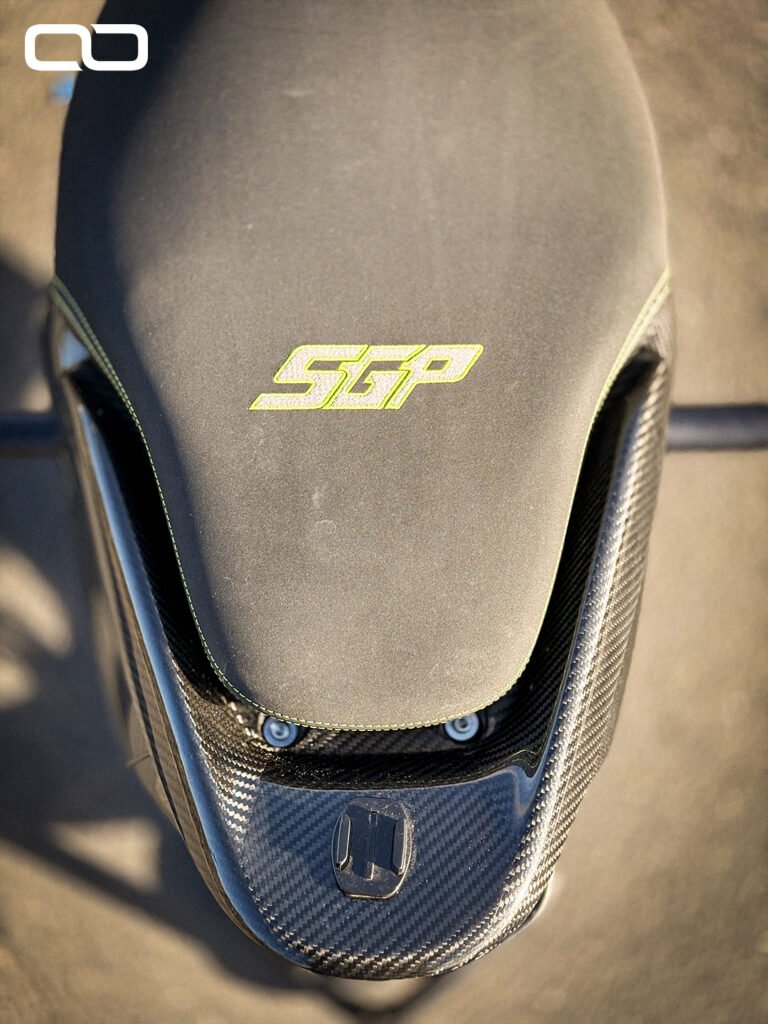
For the fairing section, Kevin is completing the full set of Jog-RR fairings, with just two details left. As you can see from the photos below, this bike is covered from head to toe in carbon fiber. That black and anthracite weave, with its unmistakable pattern, repeats from the front shield all the way under the footboard (one of the few original parts, still for a short time), and continues to the rear, where a single piece was made for the side panels and a second piece for the ducktail spoiler.
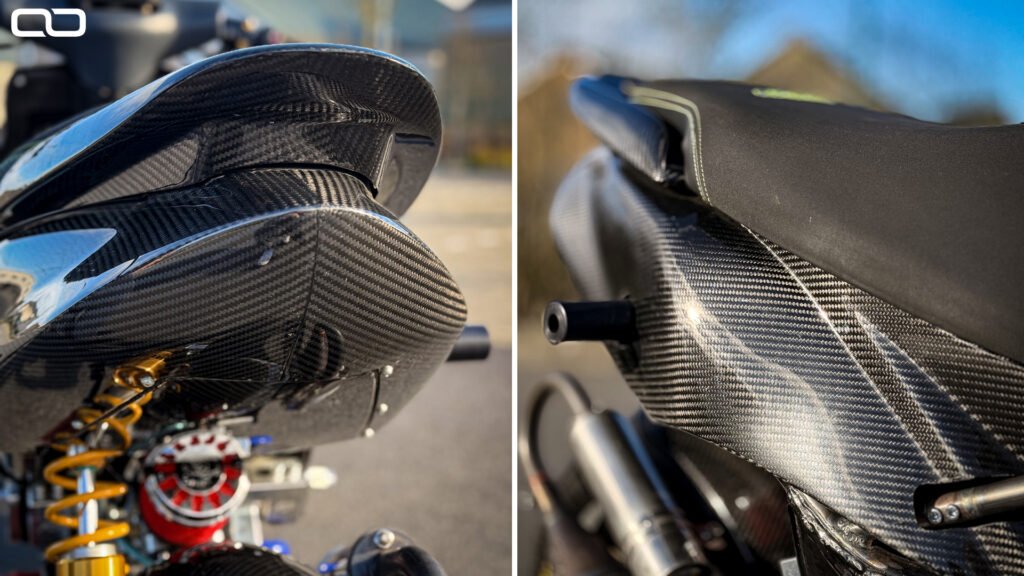
L’ultimo dettaglio è la sella completamente rivista nella sua fisionomia ribassata sul posteriore, con un profilo più “rettilineo” e impreziosita con un rivestimento custom by SGP.
Well, we’ve reached the end, but before we wrap up, I’d like to say a few words about this bike. It’s beyond logic, and that’s why I chose it and bothered Kevin for an entire month with interviews, photos, videos… he was absolutely superb in sending me high-quality material and giving me his time to write this piece.
Lately, you’ve all seen incredible scooters appear on these pages, but I want every young rider to understand something. The Scooter of the Month is not a series created just to show ever crazier scooters with components coming straight from MotoGP or hyperspace. It’s a series of article that wants to tell the story of your scooter, how it was born, its project, and why not, to tell the story of the person who designed and built it, and the passion that shines through in its creation.
So, whether you have a 40,000€ track monster or an everyday scooter that takes you to school or work, it’s very likely a piece of you, an object that works in symbiosis with your freedom to move or express yourself, customized to your taste. In short, The Scooter of the Month is you and your bike, and if you want to be part of it and share your story with us, I’m here, ready to put it down on paper.
Kev, once again, thank you!
Below you’ll find the full gallery of the Jog and some additional photos that weren’t included directly in the article. Thank you for reading, and if you want to apply for future articles, contact us without hesitation!

No responses yet